Up Sucker Creek

Up Sucker Creek
Photo Courtesy of the Lake Oswego Library

Saturday, January 17, 2015

Changes in Old Town

Albertson's will shutter State Street store in February

The Lake Oswego Review (January 15, 2015)
 reports that the Albertsons store on State Street will close for good sometime in February.  This will leave a big hole in the State Street shopping center, and diminish food store choices for those living in the East End and Old Town.

What will happen with the space?  The property owner has a FOR LEASE sign out front, but someday the property may be sold for redevelopment.

Remember the Foothills Development Plan and the Portland to Lake Oswego Streetcar Plan?  Each had earmarked the Albertsons proprty for development related to a streetcar line.

As the LO Review points out, when Albertsons is gone, the Safeway store on A Avenue will be the only grocery store left in the East End.  And... the Safeway block is marked for other purposes in the revised (2004) Redevelopment Plan.  Who knows if a grocery would be included in a new development.

If the Safway closes too, and there is no replacement all-purpose grocery store, then the grand plan of having a walkable town center where residents can "meet their daily needs" within a half-mile of their homes is DOA. Old Town will be in that situation after February.  Maybe people will eat out more.

All the plans and planning are doomed when executed because humans rarely behave the way they were supposed to, and the market does what it does, irrespective of one city's plans. 

Give it your best shot!  Predict the future!
If the Albertson's property is ever redeveloped:  what do you think will happen on the site?  Should the present Oswego Village buildings remain or should there be apartments there instead?

Here are other plans for the area that have been created from 2010 to 2012, but maybe you see something the planners and designers didn't.


More to read

Don't forget to check out the "LO Scorecard" blog for what's happening inside City Hall.  You won't find this kind of news anywhere else!  Read the latest post, "Who does the city serve?"

Heavenly

May this video bring beauty to your day.  
Adam Simmons:  St. John's Bridge 2015


Click on image for video link.

Where the kids are


Milwaukie: Down The Road, On The Rise
MetroParent, September, 2014  By Courtney Sherwood 

Speed through Milwaukie on Highway 99E and it's easy to get the wrong impression: Fast cars, wide lanes and strip malls dominate the landscape.  But if you're willing to slow down and take city streets, you'll soon learn there's much more to this community of 20,500 people.  

"It's a delightful place to raise a family," says Danna Freeman, who has lived in Milwaukie for 21 years, 14 of them selling real estate in the area.  She moved to the community because of its sense of place and local schools, and stayed because of the mix of small-town community and big-city access. "We're so close to the city, five minutes from Sellwood, but so many people never think of living in Milwaukie."

This summer, Milwaukie home sales were up 10 compared to a year earlier, according to data compiled by the RMLS real estate listing service.  About half of Milwaukie homes sold for more than $290,000, half for less.  Recent real estate listings show a three-bedroom, 2,400-square-foot house with an asking price of $219,900.  A 2,600-square-foot house with four bedrooms, 2.5 baths at the end of a dead-end street listed at $324,900.

Families looking for average can find similarly priced houses outside Milwaukie's strict city limits, Freeman says.

Melissa Thomsen, a stay-at-home mom to three kids, first moved to Milwaukie with her husband and her then 4-year-old in the spring of 2006.  She'd been living in southeast Portland, and loved the walkable neighborhoods there.  But her husband had, as she describes it, "a lot of toys," including a boat and a dune buggy, so they were looking for a home with at least a two-car garage, plus enough room to hold the family they wanted to grow.  In the still-overheated market of 2006, that proved hard to find in Portland.

"We wanted to settle down," Thomsen said. "We wanted to be somewhere for a long time."

*
The article goes on to describe the virtues of suburban, small-town living.  The Thomsen family's home is close to the river and they have a view of downtown Portland and OHSU from their deck, surrounded by mature oak and fir trees.  They can walk to their church, go to a Farmers' Market during the summer, bike and walk around town, enjoy Milwaukie's restaurants and still get to Sellwood and Portland quickly for whatever else they need.  They love the schools and most importantly, they can afford to live there!

This is what Lake Oswego is competing with - it is what Lake Oswego used to be: a small town with small-town amenities and close to big-city services.   Lake Oswego used to be affordable for people of varying incomes - a family town.

There is no place in Lake Oswego for a lot of young families anymore: the houses are too expensive, utility costs are through the roof, and despite what planners and developers might say, most families don't choose to live in the apartments that are being forced on the suburbs now.  If I were young again with school-aged children, I'd be checking out low-density, affordable and friendly Milwaukie, and probably by-pass the Lake Oswego of today.  The youthful energy has gone to the other side of the river, and it won't be coming back for a long, long time.


Friday, January 16, 2015

How Lake Oswego will develop

The compact shopping district downtown has been in the East End Redevelopment Design from the beginning.  The original 1986 plan adopted by the City Council can be seen HERE.  The 2004 revised Redevelopment Plan (including addendums) is HERE.

In 2004 the City Council under the leadership of Mayor Judie Hammerstad enlarged the plan to include more projects, increase density, and add a specific "Lake Oswego Sytle" that must be applied to all new buildings.  The small-scale village that was envisioned in the beginning has given way to the village on steroids that is emerging today.  Given the number of projects and blocks yet to be redeveloped, the end result could be a massive transformation of what we have now - which was what was intended in ten years ago.  The Wizer Block development will be only the beginning.  Lake Grove has similar concerns, but the interest there is not so intense.

There are a couple of issues coming before Council this month (and beyond) that could have a huge impact - for the better or worse - depending upon what kind of growth happens in the city and what you prefer.  One is the North Anchor Project Plan, the other is the new Clear and Objective Housing Standards.  

 
City Council Meeting

January 20, 6:30 pm


The public hearing on Tuesday will focus on codes that define what developers, who include housing in their developments, can do if they want to avoid public review by the Development Review Commission, or an appeal of a decision.  The "clear and objective housing standards" must present a "clear and objective" path for any developer to follow to make it easier for "needed" housing to be built.  

Whenever housing is included with retail or other commercial uses such as in the Wizer Block development, the new codes would apply.  Imagine the Wizer Block development as originally envisioned (at 5 stories!) being
approved by staff only, with no review by the DRC or the City Council, and no objections or right to appeal for those pesky, obstructionist citizens who don't like big buildings.  This is the future with C and O standards.

Developers and the Chamber of Commerce folks LOVE this state law!  What's not to like?   If community development codes were written with the citizens, neighbors and neighborhoods in mind, the angst and anger that comes with development causes would be markedly diminished, and everyone could be a winner.  Under a discretionary path, a developer may elect to do something outside the objective code track and have their plan reviewed.

ATTEND THE HEARING!  SEND YOUR COMMENTS TO THE CITY COUNCIL!

What do YOU want to see happen?  Choosing to look at the codes in a different way is possible if the council feels those proposed don't reflect the city's best interests.  It is my hope that the interests of citizens outweighs those of developers.  We need development, but there is a path we can all be comfortable with.  This one isn't it.

If everyone isn't talking, the best ideas aren't heard

West Linners are now part of the anti-Metro/density/smart growth backlash

Even people who welcomed the Metro grant to revitalize the Arch Bridge area are hollering now that they have seen what the planners came up with.  Ideas for a more modest development that fit the space and enhanced the character of the nearby historic neighborhoods are threatened, if not erased completely.  There is only ONE type of PLAN that comes from of Metro grant applicants - dense mixed-use development that firms a "Town Center" or "Station Community" - about the same thing except station communities are built along light rail lines (or other major transportation corridors).

Another citizen opposition group has formed.  Another community is riled up.  There is no secret that the region is showing growing dissatisfaction and open rebellion to the State's and Metro's Smart Growth (aka Climate Smart Communities) planning.  It is a tragedy that there is no one at Metro looking out for the common man and what the public at large wants.  Even with their latest survey of housing preferences, Metro has not changed course or let up on its apparent goal to see a majority of the region's population in multifamily housing.

*

Don't Be Dense
Portland's apartment fights are headed to the suburbs.  Next stop: West Linn 

Willamette Week, December 3, 2014  By Aaron Mesh

Excerpts:
Portland's clash over density from the condos and apartment blocks lining Southeast Division Street and North Williams Avenue is spilling over into the suburbs.

The next focal point: a stretch of prime waterfront in West Linn. Today, a paper mill, a gas station and ramshackle wooden apartments anchor the site, a 30-minute drive south of Portland.  


But there’s growing opposition to West Linn’s plans from residents who worry that Metro’s planning agenda will turn their leafy bedroom communities into condo bunkers like those that now tower over many Portland neighborhoods.


Debate over the plan has been raging in the pages of the West Linn Tidings. A neighborhood association has called for a delay. Peggy Kirkendall has formed a new citizens’ group, West Linn Neighbors, to protest the plan.


“There’s a real pattern, especially in the western part of the United States, where we take perfectly livable places and grow them to death,” says David Dodds, a former West Linn mayor. “If you like the character of where you live, then you’re likely to not want to see it changed to something else. Otherwise you wouldn’t have moved there to begin with.”


Letters to the Editor
West Linn Tidings, December 4, 2014
Understanding Metro's playbook for land use
By Peggy Kirkendall

While perusing Metro’s website, I happened upon a 58 page document, “The Principles for Achieving Region 2040 Centers,” which basically is a playbook to achieve the growth and density goals of Metro at the expense of citizens and neighborhoods, but definitely in favor of developers: oregonmetro.gov/sites/default/files/07022002_ten_principles_for_achieving_2040_centers.pdf 

They give lip service to citizen involvement while talking about taking down “barriers” which are citizen groups that want to slow down the process. The goal is to get things done quickly through unanimous support from elected officials, reducing code and zoning restrictions to attract more developers. It’s slick, cheesy and creepy.


It’s all about public-private partnerships ... the kind where the public abdicates their responsibility in favor of appeasing private developers.


Rather than going with a model based on public-private partnerships, why not consider doing an entirely public project where City Council goes after a bond measure to allow for a unique design for the historically rich area as the arch. It removes the need for office buildings, oversized residential and instead focuses on tourism drawn by a beautiful inn modeled after the one that once graced the area, small shops, enhanced access and views of the river and the falls, and a place to showcase the Indian heritage, not to mention wonderful wildlife. Forget density; focus on history, nature and tourism. Consider a national park or heritage center designation to obtain operating funds. The arch bridge is far too unique to turn it into an Orenco Station or anything even slightly close.

It’s time to think outside the box. If we need to return the grant money, so be it. It’s a small price to pay for a real gem.


Wednesday, January 14, 2015

North Anchor comments wanted

The Lake Oswego Redevelopment Agency is asking the public to weigh in on what they do and don't want to see happen with the North Anchor Project.  There is an Open City Hall forum for citizen comment.  The deadline for commenting is January 16, just 2 days from today!   Check it out today and give the LORA board your best ideas!

There is a Community Forum scheduled to introduce the North Anchor Project and solicit ideas on Saturday, January 31 at the Adult Community Center, 505 G Avenue, from 9 am to 1 pm.  The city is requesting advanced registration which can be accessed using the link above.  If you neglect to register, go anyway - public participation is vital.  


What would you like to see happen at the downtown's North Anchor Project site?


Consistent with the 2004 East End Redevelopment Plan, the Lake Oswego Redevelopment Agency (LORA) is planning a mixed use development project on the north side of B Avenue at First Street.  This project is envisioned to be an anchor for the First Street retail core in downtown and create a northern bookend to the successful Lake View Village and Millennium Plaza developments. 


  1. What would you like to see developed on the North Anchor properties that would benefit downtown and our community?
  2. What would you not like to see as part of this new development?


Tuesday, January 13, 2015

Cities of the future?

From The Wall Street Journal, October 21, 2014:  
They're Tracking You When You Turn Out The Light 

Municipal Sensor Networks Measure Everything From Air Pollution to Pedestrian Traffic; Building ‘a Fitbit for the City’  


By Elizabeth Dwoskin
Excerpts:

Four percent of Manhattanites go to bed before 7:30 p.m. on weeknights. Only 6% turn off the lights after midnight.


For more fine-grained data on what makes New York City tick, ask researcher Steven Koonin. Hidden on a Brooklyn rooftop, his wide-angle infrared camera peers at windows of thousands of buildings across the East River. The camera detects 800 gradations of light, a sensitivity that lets his software determine what time households turn in, what kind of light bulbs they use, and even what pollutants their buildings emit.

He has also mounted sound sensors in Brooklyn on streetlight poles and building facades to gauge the volume of house parties and car horns.


Tech companies have used the technologies and techniques collectively known as big data to make business decisions and shape their customers’ experience. Now researchers are bringing big data into the public sphere, aiming to improve quality of life, save money, and understand cities in ways that weren’t possible only a few years ago.

In doing so, researchers are raising questions about the proper balance between privacy and efficiency. Municipal sensor networks offer big opportunities, but they also carry risks. In turning personal habits into digital contrails, the technology may tempt authorities to misuse it. While academics aim to promote privacy and transparency, some worry that the benefits of big data could be lost if the public grows wary of being monitored.

“For a long time, people living in cities pretended that they could be anonymous,” said Anthony Townsend, author of the book “Smart Cities: Big Data, Civic Hackers, and the Quest for a New Utopia.” “It’s not about anonymity but about surveillance. There is a real reckoning that’s going to happen.”

U.S. Attorney General Eric Holder recently pointed out the dangers of so-called “predictive policing.” Police in Los Angeles and Chicago are using historical crime data, another example of data mining, to predict where offenses will erupt, a strategy that sends officers to knock on doors and warn residents to stay within the law before they’ve committed a crime.

* * * * *

Mystical references to “society” and its programs to “help” may warm the hearts of the gullible but what it really means is putting more power in the hands of bureaucrats. — Thomas Sowell

Sunday, January 11, 2015

About trees 1 & 2

About Trees: 1

File this under "right tree, right place."  These are some pretty nasty trees.  Anything more that I'd have to clean up after is unwelcome in my yard! 

11 Trees You Should Never Plant in Your Yard  


Some trees are more trouble than they're worth.  Before you head to a nursery, see our slideshow.  Then, see even more trees readers love to hate!  


Note:  Only the female ginkgo trees are troublesome and bear fruit; male trees are fine.
There are thornless varieties of honey locust available.   


About Trees: 2
Below are comments from the Portland Tribune article, "Has city gone too far out on a limb?" about Portland's new tree code.
  The comments are notable because they are predictable.  In light of Portland's ridiculusly intrusive new tree regulations, people are rebelling.  People lose their respect for government when laws are disrespectful of people's rights and sense  of fair play.  
  In cases where landowners know their trees will soon be regulated, you will see a rush to cut trees down, even where the owner has lived with the trees for decades and likes their trees.  When you tell someone that the government will control their property, they tend to do things that keep the government off their property and out of their lives.  

This is what happens when government bureaucrats and elites believe they khow best how to manage the masses.  It doesn't work, unless we are living with in tyrannical state, because the only power the government has to enforce its laws is the power of police force.  

Comments:
cpvo
This is ridiculous. I'm glad I cut down two of my old and dying tree.

And I'm even more convinced that the Mayor and City Council are determined to make all the middle income residents move out of Portland, leaving the rich, the poor, and especially the homeless (Hales wants to build them special tiny houses).


Scoots
"Take the requirement that people must get a permit before pruning twigs on street trees in front of their house as small as one-quarter-inch diameter. That’s about the size of a pencil."

Ha ha. Good luck.


realist 
Sheer lunacy..Who is going to. Optics of a 2"diameter tree is 
missing ,the "tree police " ?

Too bad there was not more involvement on the part of those affected before this ludicrous item was put into place. Makes me glad I moved form the city of greed years ago.

Gollehon Family
Reading the artical is just yet another conformation that even the people that are in charge of inforcing the new code, don't know what they are talking about." The new street tree pruning code makes it easier". This is not true, the old method was applying online, you did not have to hire a certified arborist to fill out the applicstion & do the work. This is going to cost everyone involved more time, money, and the same people working under the radar will still be doing so


Saturday, January 10, 2015

Boring's wish

Boring's Quest in 2015

With half of its land inside the Metro boundaries and half outside, life in Boring can sometimes be confusing - and unfair.  Depending upon which side of the line one is on, the rules can be different, and this can cause friction among neighborhoods and make extra work for anyone trying to do planning for the community.  

Boring wants to withdraw from The Metropolitan Serrices District altogether.

Boring wants to be made whole. 

A group of citizens collected over 600 signatures (representing 25% of the registered voters from the withdrawal area) on a petition to send to Salem requesting a law that would adjust Metro's boundaries to exclude all of the Boring community.  The petitions were presented to the Clackamas County Board of Commissioners and the Metro Council on January 8.  More information is available in The Northwest Connection, excerpt below:


"This measure is brought forth to establish unity in the Boring community, which requires that local governance be fair and equitable.

The people of Boring look to the State Legislature for the passage of the House Bill that takes Boring out of the Metro jurisdictional boundaries and creates an environmentfor fair and equitable local governance and a prosperous future for the community of Boring."


Self-governance and self-determination is at the core of American ideals.  NO town or jurisdiction should be governed by what is essentially a federal agency ("regionalism") without the express wishes of the people.  

Boring's circumstances may be unique, but many other towns and areas are running from Metro's overreach --into their neighborhoods, their pocketbooks and their lives - think Damascus, Stafford Hamlet, Tigard, Tualatin and Clackamas County - each throwing up barriers to Metro's unwanted planning for their towns and communities.  At some point, the State legislature itself will have to look inward to see how much they contribute to the oppression being felt in the region, and rescind or make voluntary their goals for our future.  


Go ahead, throw it out!

Seattle has officially become a nanny state.  All the good places are going crazy.  It's like watching your favorite pro baseball player be sent to the minor league.  Really?  A big city waste collection system has the time and inclination to go through people's garbage to see if there's food in it?  What a rip-off for multifamily properties, especially rentals.  Are owners or managers supposed to inspect residents' trash 24-hours a day when it goes into the dumpster to keep food out or to fine individual scofflaws?

Who makes up these rules anyway?  I can just see them now - a bunch of people with way too much time, an abundance of ideology and not enough life experience to know the limits of the willingness of humans to be manipulated like lab rats.  Don't let me down humans!  Have some guts - toss out some banana peels!

When was the last time your garbage collector looked in your trash bin?  

Seattle to begin fining people who put food in trash

The Oregonian, January 7, 2015  By Kelly House

Seattle is laying down the law on residents who violate the city's new trash law by putting food in their garbage bins.

The city has begun putting red tags on the cans of violators, KUOW radio reports. For now, the tag is just a warning. But come July, residents who dump food scraps in the trash will pay $1 each time they violate. Fines for apartments, condos and commercial buildings will be higher.


The soul-sapping death of smart cities

Jane Jacobs is often heralded as the planning world's heroine - the woman with determination and grit who saved Greenwich Village from being destroyed in the 60s to make way for a freeway.  She fought for a city neighborhood brimming with life that she described eloquently in her 1961 classic, The Death and Life of Great American Cities.

Unfortunately, only a portion of Jacob's message has made it into the modern planners' lexicon:  "eyes on the street," "walkable neighborhoods," "24-hour neighborhoods," and (ick) "vibrancy."  But they seem to miss what actually motivated Jacobs' campaign - the idea that neighborhoods belonged to and were defined by the people who lived in them, not the professional planners who knew better how the masses ought to live.  They also missed the part about the blending of the old and new, and the low-rise buildings that gave the streets a human, livable scale.


In their push to force a top-down, developer-friendly, high-density agenda, planners today are not thinking about who they are designing for, and much like Robert Moses, most do not respect or understand the indigenous cultures they encounter.


On Chatterbox, Brian Libby's blog on Portland architecture, he posts an interview with planning researcher Andrew Powe, excerpts below: 

From simply looking around, Jacobs believed that low-rise streets with mixtures of older buildings provided the most vibrant urban communities, the best places for small business innovation and safer public places.  She railed against skyscrapers and the scrape-and-rebuild philosophy of urban renewal aimed at eliminating urban "blight." 

Many planners struck back with venom.  Old buildings, they said, stood in the way of progress.  Cities that did not renew themselves were doomed to eventual failure.

Now there is impressive new evidence based on massive compilations of data that were not available in Jacobs' day.  Bottom line?  "Jane Jacobs was right," said Michael Powe, senior research manager for the Preservation Green Lab, a Seattle-based research arm of the National Trust for Historic Preservation. 

Powe, who holds a doctorate in
planning and design, laid out the results of the trust's "Older, Smaller, Better" research report in a talk in Portland on October 7 at the Architectural Heritage Center.  Based on intensive statistical analyses performed with data from Aeattle, San Francisco and Washington DC, the report says commercial streets with a mix of building ages and sizes provide the most economic, social and cultural benefits.  

Powe did not describe himself as a preservationist.  And he expressed no intellectual virulence against new buildings on vacant land.  "Where you have the old and new rubbing together , there is greater friction and greater street life," Powe said.  

Streets with the highest [character] scores were those with the highest variety of building ages and sizes and with multiple ownerships.  In general, these same streets had the best walkability scores, the most independently-owned businesses, the most minority and women-owned businesses, and the most successful independent bars and restaurants. 

"A lot of these things we already knew," Powe said of the Green Lab conclusions.  "The data are important to policy-makers.  It is good to have the numbers to back it up."

The bottom line of Powe's message: "Character and scale of buildings matter.  Think about preservation.  Think about why it works.  Don't be afraid to blend old and new.   Don't tear down all old buildings.  Be smart about design.  Encourage the interplay between old and new."

Score these photos:
Hawthorne Blvd., mix of shops of different sizes and ages.


New mixed-use development on Hawthorne Blvd. 

Friday, January 9, 2015

Our future is tied to the past


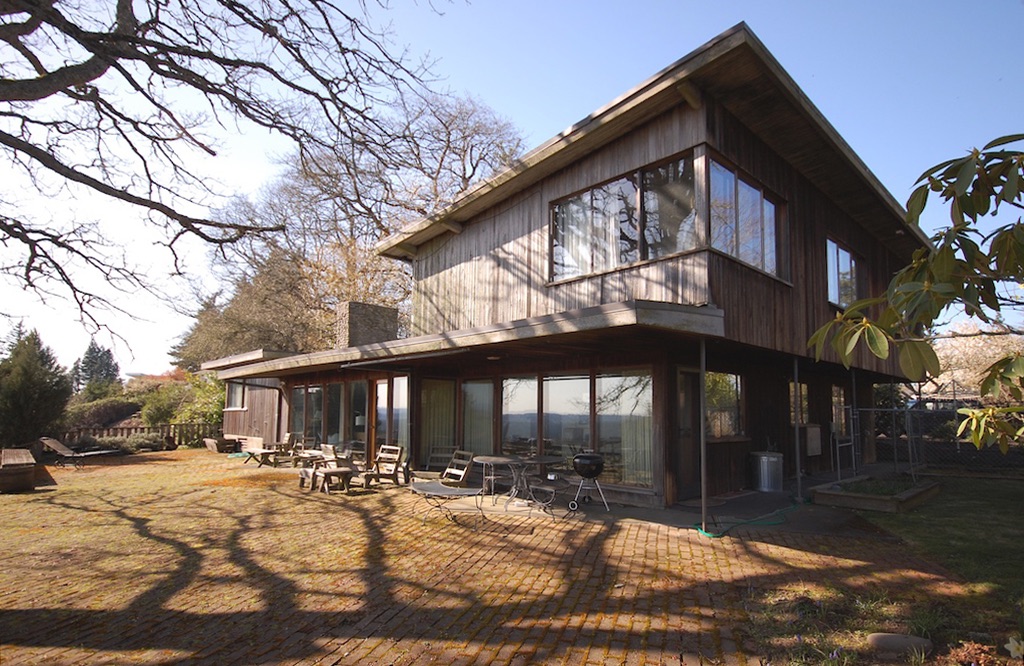
Left:  The Richard Martin House, Lake Oswego, Designed by James Van Evera Bailey

Status:  Gone


Below are excerpts of the comment on Open City Hall left by Mary Lou Colver, President of the Lake Oswego Preservation Society.  The subject is compelling and should be of interest to anyone who fell in love with Lake Oswego and chose to make it their home.  Bigger isn't necessarily better.  When parts of our city are systematically being torn apart, the character and soul of the city changes.  To some degree this is natural, but the best cities have older residential districts with historic homes still intact, and cities with a variety of ages and styles of buildings are the most interesting and vital.  Not every building is worthy of preservation, but for various reasons (see below), all older buildings need to get a second look before the bulldozer does its thing.  Affordable housing?  Mid-century gems?  Neighborhood character?  All are part of our present and past, and worth a chance to be part of our future.


Open City Hall 
Comments solicited for the 
City Council 2015 Goal-Setting Retreat  

In the last 12 months, a demolition permit has been issued approximately every 8 days. According to a Permit Technician, the cost is $95 plus $320 for erosion control. But what is the cost to our history, our neighborhoods, the environment, our sense of place, and our local economy?

Like pieces suddenly ripped out of a patchwork quilt, it can take a few hours for a backhoe to destroy the decades-old, sometimes century-old, fabric of our neighborhoods. Without a sign posted, a notice to neighbors, or photo documentation of these buildings, they truly disappear without warning and without a trace.


It’s time for new ideas and a fresh approach to the demolition of single-family residences in Lake Oswego. There are many persuasive reasons why we should not continue to throw away our buildings. The Society has come up with the following “S.A.N.E.” approach to emphasize the most pertinent reasons:


S is for sustainability. Reusing an existing building is the most sustainable choice that can be made. It’s ironic that citizens dutifully recycle cans and bottles while landfills are mounded to capacity with the rubble of what once were perfectly habitable homes.


A is for affordable housing. When we lose our older housing stock we are eliminating affordable housing and this choice is changing the demographics of our city and making it less diverse.

N is for neighborhood character. The fabric of our neighborhoods is being torn asunder and the charm that attracted homebuyers in the first place is being gradually replaced by homes that shout: Anywhere, USA.


E is for economic development. Rehabilitation of older buildings contributes more, in the long term, to the local economy than new construction. Donovan Rypkema is a leading expert on the economics of preservation. His report entitled Measuring Economic Impacts of Historic Preservation may be found online at: http://www.placeeconomics.com/wp-content/uploads/2012/02/economic-impacts-of-hp.pdf 


Read the remainder of Colvers comments at Peak Democracy (link above).


Home building in 1949

How to Build an Igloo
CITYLAB  January 6, 2015  Mike Byrnes

With the first snowfall of 2015 arriving along parts of the U.S. east coast today, it's a good time to review all the important winter safety tips: drive slowly, shovel your sidewalk, and stack snow blocks in a continuous spiral in order to create a structurally sound igloo.

This last tip comes from the National Film Board of Canada's 1949 classic, How To Build an Igloo, republished on the organization's YouTube page this morning. In it, cameras follow two Inuits who have ventured out from their family's winter camp to trade at a post along the Hudson Bay, where mostly flat lands provide no relief from the brutal cold.