Up Sucker Creek

Up Sucker Creek
Photo Courtesy of the Lake Oswego Library

Wednesday, August 20, 2014

A new housing trend in Portland?

Could this spell hope the future of Lake Oswego, it's town centers and its neighborhoods?   


City ponders an about-face on density 
Portland Tribune, August 19, 2014, By Steve Law


Planners mull 'down-zoning' to relieve pressure on some areas
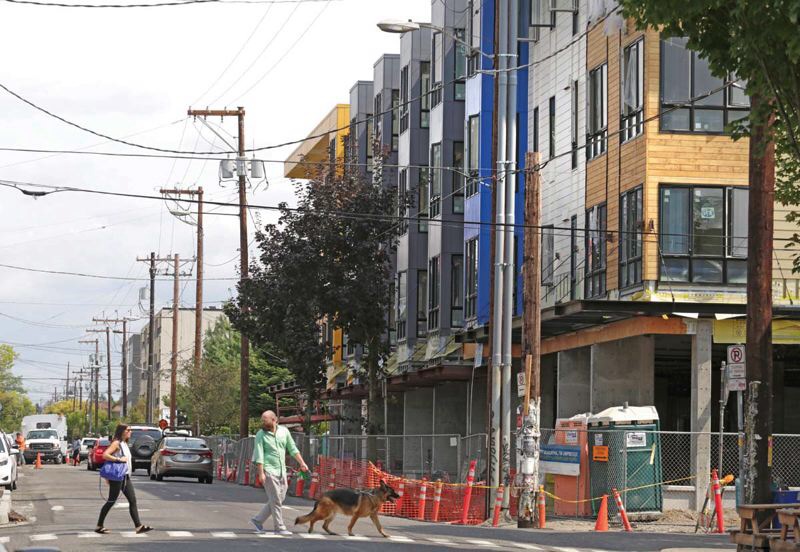

Photo Credit: TRIBUNE PHOTO: JONATHAN HOUSE - A new mixed-use apartment complex is nearing completion on Southeast Division Street and 33rd Avenue.

The city of Portland — often incurring the wrath of residents and neighborhood associations — has scrambled for two decades to increase density via infill developments, row houses, apartments and condos.
Now city planners are plotting something unthinkable in the 1990s and 2000s — reducing density.
In the proposed comprehensive land use plan designed to guide Portland’s growth through the year 2035, planners are proposing lower densities on 2,100 acres of land throughout the city. It’s known as down-zoning.
“It’s been a half-century since we’ve had this much down-zoning,” says principal planner Eric Engstrom of the Bureau of Planning and Sustainability. The last time the city undertook so much down-zoning was 1959, he says, when many close-in neighborhoods were rezoned to bar apartments and only permit single-family homes.
None of the proposals are written in stone, as the city has just started taking public testimony on the long-awaited update of the 1980 comprehensive land-use plan. And to be fair, that “comp plan” also calls for increasing densities in many parts of town, especially on commercial corridors and intersections such as Southeast Division Street and 122nd Avenue, Barbur Boulevard and Capitol Highway, Killingsworth near Portland Community College, and several inner-eastside corridors.
But the changing tide on density is notable. Ever since the mid-1990s, when Metro released its Region 2040 Plan to chart growth for the next 45 years, Portland and every other city in the metro area has been under pressure to increase densities and do their share to accommodate expected population growth.
At the time, he says, Portland couldn’t demonstrate to Metro and state land use regulators that it could spur large new residential communities in existing inner-city neighborhoods such as the Pearl District or South Waterfront.
But residents have since flocked to those and other close-in neighborhoods. So now planners are saying they can accommodate growth in hot spots such as the Lloyd District, downtown, and four-story apartments on inner-eastside corridors such as Division, Hawthorne, Belmont and Burnside.
“Under the current zoning rules, Eastmoreland as we know it could easily be gone in five years,” says Robert McCulloch, president of the Eastmoreland Neighborhood Association. “Basically, a vast majority of the homes will be eligible for demolition.”

Will planners and politicians save the suburbs and not try to urbanize already built-out cities like Lake Oswego?

Tuesday, August 19, 2014

Apartment boom and bust

Is the timing for the Wizer Block apartment project past?  Is the apartment market becoming over saturated?

From the Barry Apartment Report: Spring 2014 

HEARD ON THE STREET
“The smart money is saying if you’re not out of the ground now, or very close to getting out of the ground, you might have missed the boat.” Craig McConachie C&R Real Estate Services

“Fully supplied, not oversupplied in 2014. The apartment sector may flirt with over- building, but this industry can lay off the gas pedal fairly quickly.” Real Estate Analyst—2014 ULI Emerging Trends

“Retail is a fine idea, but as a planning tool, I think it’s been applied too liberally. It’s over-supplying the retail market essentially,” Spencer Welton, Simpson Housing, regarding ground floor retail at many of the new apartment buildings. 

“If you want a snapshot of what Portland chic has become, just drive—well, maybe you’d better bicycle—down Division Street between SE 31st and SE 44th Avenues.” Willamette Week 

“Setting bare minimum standards and then offering developers a thousand ways to dodge them is a short sighted calculation masquerading as big city thinking,” Oregonian editorial 

Is time right for a comeback by condominium projects?
Daily Journal of Commerce, August 18, 2014, By Inka Bajandas

Industry professionals monitoring construction of first Portland condo tower since recession


Construction of Hoyt Street Properties’ 28-story Block 15 condominium tower in the Pearl District is prompting discussion whether more such projects could follow in Portland. (Rendering courtesy of Boora Architects)

Becky Scharf is watching progress of Hoyt Street Properties’ Block 15 condominium tower under construction in the Pearl District. But what the principal broker at Urban Properties Group really wants to know is if the first condo project to emerge in Portland after the recession is a sign of more to come.
“I have clients asking me about new projects all the time,” she said. “Everything is leased out. Definitely, we could use more inventory.”
Scharf and other Portland-area brokers say too few Portland condos are available in areas like the Pearl District and South Waterfront District to keep up with rising demand.
The idea for Hoyt Street Properties to build more condos didn’t come up until the company teamed up with developer Joe Weston, who pointed out that Portland’s rental market was starting to become oversaturated, Hoyt Street Properties President Tiffany Sweitzer said. She also reasoned that in the time needed to build another condo project, the market would improve.
“We started to look at the resale market take off,” she said. “We thought we have an opportunity. We can be the first one out.”
Block 15 will capitalize on the tight market for Portland condos, Becker said.
“There is just not a lot to choose from right now,” he said. “That’s something that Block 15 has going for it, but it’s going to come at a premium.”

Metro's "innovative" codes

Form-based codes.  The transformation of suburbia to higher density, more urban development patterns.  

Metro's Community Investment Tools

Innovative Design 
and 
Development Codes


Innovative design and development codes: tools for investing in our communities 

Model approaches and tools in the toolkit
  FROM SUBURBAN TO HIGHER DENSITY URBAN
How can we make graceful physical transitions from suburban development patterns to a higher density, more urban, pedestrian- oriented character?
Public realm transitions
• Pedestrian improvement requirements 
• Ground floor active use provisions (Mixed use retail, office or other commercial)
• Design and development standards
• Minimum floor area requirement (Floor Area Ratio - higher FARs mean higher density)
• FAR bonus (Typically a density bonus for adding housing)
• Flexible parking requirements 

Density and use transitions
• Non-compliant use provision (Helpful when transitioning from one land use to another)
• Development Agreement 

TRANSITIONS IN SCALE
How can we improve the relationship between buildings and zones of different scale through creative design approaches that also maintain support for compact development in centers and corridors?

Code flexibility to support contextual design
• Form-based codes (Disregards old zoning land use codes)
• Menu-based codes
• Improved objective design standards (Streamlines developers's projects with little or no  
                                                               development review or public input)

Transition zones for better contextual design
• Cottage housing development code provision (No zone allows for clustered housing on LO - yet)
• Stepbacks
• Transfer of development standards 
• Mixed-use development standards (All commercial areas may become mixed-use zones with 
                                                           upcoming code changes. This would drastically change the city.  
                                                           Is anyone talking about this?)

PARKING
How can we best provide parking in areas targeted for compact development to achieve desired levels of density and urban forms?
Managing parking to maximize urban form
• Parking supply inventory (Number and location of on-street and off-street parking spaces in a given 
                                            area.)
• Structured parking (Above or below ground parking garages - replaces standard lots)
• Removing parking minimums (No need to provide for minimum parking needs - we're all going to 
                                                    walk, bike or take transit everywhere!)
• Parking maximums  (Limit on how many parking spaces a development can offer - usually designed 
                                    to be minimal and ignores the fact that people drive cars.  See above.)
• Unbundling parking (Separating parking from development or use; parking can be on-street or in a 
                                    lot shared by another business, but no more parking at the building you want to
                                    go to, but there won't be enough parking anyway.  See above.)
• Parking benefit district (This is where the developer, not the public, benefits.)
page5image12516

PUBLIC INVOLVEMENT
How can multi-faceted codes and planning documents be translated effectively to developers and the general public to articulate a clear vision for future growth that can be rendered in built form?
Visualizing zoning 
• Urban design plan   (We need graphic representations and educational seminars. Right now, only 
                                   the planners know what they are doing to the city.)
• 3-D modeling (This would be wonderful!  What would the city look like with proposed new codes?     
                          We should know.)
• Urban form focused codes and code guides (Codes that dictate the shape and bulk of buildings 
                                                                         rather than what they are used for. Form-based codes 
                                                                         are best for mixed use and transforming areas into 
                                                                         higher density urban shapes.)


How can we engage neighborhoods to build support for the implementation of the region’s 2040 vision?
Involving neighborhoods
• Neighborhood grant program
• Educational series                                                      
• Outreach and education program    (Any effort to allow the public to SEE what codes will do to/for 
the city would be great! Then allow citizens, not just advisory groups to have a say in what the city should look like - regardless of what Metro wants!  Maybe we should even vote for a plan - not just the Comprehensive a Plan full of policies, but 3-D models and descriptions of how the city would 
function when fully built out.  Modeling should be a requirement for all code changes.)

DRC Finalizes Wizer Decision

Development Review Commission 
FINALIZES its decision on Block 137
(and next there'll be the appeal)

Disclaimer:  This post is done from recall and may not have exact wording correct.  Since this is a characterization of the meeting and not journalistic reporting, it reflects my opinion as to what transpired.  If you were not at the meeting, I encourage you to watch the video recording in order to make your own judgements.  


Something was off last night and you could tell right away.  The written summary of the DRC hearings on July 30 was wrong.  The planning staff, who created the summary, had a key sentence backwards.

The Commission finds that the ground floor commercial uses, as proposed, create a high‐density compact shopping district with density that supports retail uses,

The Commission saw this right away, and all agreed that this was not the way it was supposed to be - even the two who who were in the minority on the decision.  


The Commission changed the wording to read, "does not create a high-density compact shopping district" and moved on.  This first topic was easy, but if the entire commission agreed on this item, how did the staff get it so wrong?


A discussion ensued about the merits of the reasons the three Commissioners denied the application, and for the first hour of so, the Deputy City Attorney and planners interjected comments that changed the debate.  It seemed as if they wanted the Commission to re-argue its decision and change its vote, either by inserting language into the document that nullified or confused key issues, or by encouraging contentious debate.  


After awhile, the Commission got passed the quality of the written summary and went to work revising it so that the wording matched their thinking on each point.  The Commission found that the original and revised development application, including the orally-made options, were not enough to approve the application.  The final vote was 3-2 to deny the application.


Compact Shopping District 
Specific code language says that first floor uses must be retail; there should be no residential on the first floor.  The design did not meet the requirement with regard to the purpose of the redevelopment plan. Which was to create a compact shopping district including Block 137. 


Village Character 
Is "village" separately defined by numerical codes as written in 4 places in the Development Codes?  Or is there a broader definition of the meaning of the term that must apply as written in the Downtown Redevelopment Plan?   Staff used the first definition to meet the requirement of village character.  The Commission looked at the primary definition in the Redevelopment Plan that calls for complex massing and an assembly of small scale structures.  The Commission found that the design does not achieve the purposes of the urban renewal plan in a way that is equal to or better than what is required." 

Loading

According to the National Apartment Association. mid-rise apartments can expect a turnover rate of about 52%.  With 207 apartments that would mean about 100 units would turn over in one year, or about 2 per week.  Since each tenant makes 2 trips with their belongings, that adds up to 200 truckloads of furniture and belongings moving in and out, or about 4 trucks per week.  This is an astounding number, the likes of which downtown Lake Oswego has never experinced before.  The Commission agreed that another tenant on-site (not on street) loading area was necessary.

Other
If the residential areas on the first floor changed to retail, then more parking would be necessary. 
Developers should write a plan for how they would mitigate for the impacts of construction like foundation or other damage to condominiums on Second St., noise, damage to city streets from about 3,000 dump truckloads of dirt and rocks from the excavation site, water intrusion, etc. 

Monday, August 18, 2014

Size matters


Shrinking

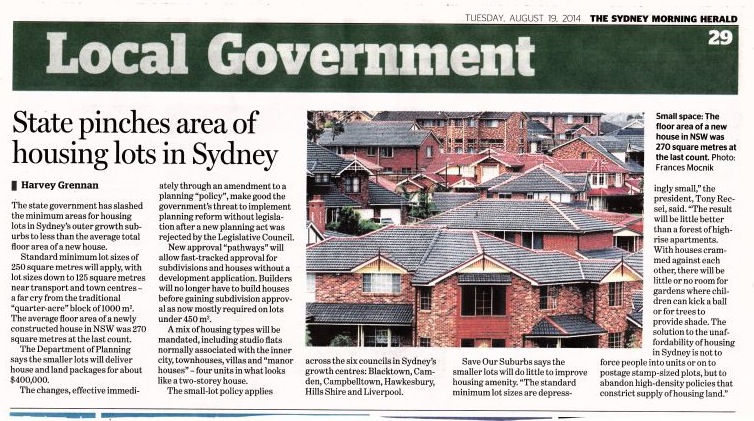
From our friends at in Australia.  If you had any doubts that Smart Growth is equally hated by citizens everywhere, yet advanced by planners worldwide, here is the proof.  

We are not dumb cattle that can't think for ourselves - but then maybe that's the problem. Independent decision-making by the masses can't be tolerated.  The world isn't shrinking, just our lots, our homes, our freedoms and our lives.  What is expanding however, is our awareness and displeasure over how we are being herded into smaller and smaller homes placed closer and closer together at a much bigger price.


From Save our Suburbs, Sydney Australia

SOS is quoted in the Local Government section of today’s Sydney Morning Herald ( see SMH 19 August 14 attached).  We express dismay at the ridiculously small size of housing lots being released – some less than half the floor area of what in the past has been an average newly constructed home.

This is all part of Government bureaucrats trying to force us into their concept of how we should live – in high-density.

Never mind that the justifications given by these mandarins are completely spurious.  Just to mention two –

·     High density does not reduce traffic congestion (even near rail stations) as can be observed in any high-density area in Sydney - congestion increases substantially. 
·     High density does not save any significant land.  See the attached diagram (SavedArea) which illustrates the small land area that would be saved if residential densities in Sydney with its current population were to be double what they actually are now.  This would save only 5 km off a 40 km cross section. Negligible, especially considering only 0.2% of Australia is urbanised. What is more, research shows jobs follow residences and work trip travel times are generally lower in lower density suburbs.

As I say in the SMH article, the solution to the unaffordability problem (and a host of other difficulties we are increasingly facing) is to abandon high-density policies.  We should implement the tried and tested planning policies that allowed the vast majority of people to choose to live in pleasant single-residential family homes that one average salary could pay for.

The Government should be enhancing our quality of life, not trashing it.


Shameful!

Subsidized affordable housing is a shameful enterprise.

Take Portland's most recent public housing project, Stephens Creek Crossing.  The previous low-income apartment complex on the property was called, Hillsdale Terrace.  The apartment buildings were tired and could have been renovated, but with government grants, the old buildings were demolished and new ones built, and they are beautiful!  The residents are truly blessed to live there.

The problem is the cost: 122 units for $53.9 million.  That's an astounding $441,800 per unit!

To put that into perspective, consider this:
  • The median cost of a home in Lake Oswego is $328,000.  A 2-bedroom condo with about 950 sf costs about $140,000 and up.
  • The Wizer Block "high end" apartments are estimated to cost about $473,000 per unit.
  • Apartments in the Multnomah area within 2 blocks, built in 1961, are basic but well kept up, are valued at about $95,000 per unit, rent for $845 for 2 bedrooms, and can be rented with a Section 8 voucher.  
The shame is that so much more could be done with $53.9 million. People prefer the freedom to choose where to live, and no matter how great the public housing looks, a Section 8 voucher is far more prized and has a longer waiting list than public housing.

For $53.9 million, 122 families could rent private housing units for 74 years.  Section 8 Voucher recipients length of tenure is 3.08 years compared to 4.69 years for public housing (HUD), so vouchers would actually go farther.  If you put the money in a trust fund, the interest could extend the 74 years quite a bit.  Add in the fact that with private. Housing, maintenance is done by the landlord and in the end, he/she hopefully makes a profit, and the property pays needed property taxes to government entities.

Government housing is built at a higher cost per sf (HUD Research), the property does not pay property taxes, and operating costs on average are about $4,589 per unit per year.*  Add to that capital expenses of about $867 per unit per year*, off-site administrative expenses, and lost Multnomah County business taxes, and public housing winds up costing many times more than the Section 8 Voucher Program.  The true costs of public housing would shock the average person. And all the while, hundreds of families could have been helped for many decades with that pile of money.
Public housing for the most part, is obscene and immoral.

Is Public housing a housing program or is it a political program?  Is the experiment better left in the past, or will we continue to build more and more public housing to defend our privileged position of not being poor?  Why can't the market supply housing for low income families as has been shown in Portland (new apartments for $70,000 each).  Or has the federal government changed the program for social outcomes rather than for housing?

*  National Apartment Association 2013 Survey of Income and Operwting Expenses

Who benefits and who loses from these outrageously expensive and unfair housing projects?

The losers are:
  • Hard working people who struggle to make their rent, who may never get or want government support, but will have to pay for the grandiose public housing through their taxes. 
  • All taxpayers whose money is wasted on these outrageously expensive programs that help a
     ew when they could be helping hundreds more.  
  • The biggest losers are the people who have real housing needs but could not access the limited spots at this or other public housing, but could have been helped with much more affordable and preferable rent vouchers.
The winners are:


  • The usual architects, contractors, bureaucrats, money-changers, non-profit workers and others who make their living from programs for the poor.  


This topic continues - read the next post for more about Stephens Creek Crossing.  

Cheeseburgers and Ice Caps

 Cheeseburgers Won't Melt the Polar Ice Caps
WSJ August 18, 2014  By Jayson Lusk  (Commentary available to subscribers only)

The next targets of the climate change enforcers will be livestock and all Americans who eat meat.

The documentary film "Cowspiracy," released this week in select cities, builds on the growing cultural notion that the single greatest environmental threat to the planet is the hamburger you had for lunch the other day. As director Kip Andersen recently told the Source magazine: "A lot of us are waking up and realizing we can choose to either support all life on this planet or kill all life on this planet, simply by virtue of what we eat day in and day out. One way to eat takes life, while another spares as many lives (plant, animal and otherwise) as possible."


James McWilliams, vegan author of the 2013 book "The Politics of the Pasture," argues that modern agricultural, and the cattle industry in particular, are part of a global food-supply system so damaging that the only moral solution is to give up eating meat entirely. 

Each to his own you might say.  But these ideas are working their way into government policy proposals.  For example, Angela Tagtow, a self-described "environmental nutritionist" formerly with the Minnesota Institute of Sustainable Agriculture,* was recently tapped to head the U.S. Department of Agriculture's effort to revise federal dietary guidelines. This is a sign that the new recommendations are likely to go beyond nutritional science to incorporate environmental considerations.  Many observers believe that meat will be specifically targeted for scrutiny.   

More broadly, the argument that modern agriculture is a leading cause of global warming is tenuous at best.  The Environmental Protection Agency estimates that U.S. Agriculture, including livestock production, accounts for only 8% of total greenhouse-gas emissions in the country.** Livestock in the U.S. Have lower greenhouse-gas footprints than in other parts of the world.
We would never trust a group of experts to set the price of beef, milk, or automobiles.  We rely on a decentralized marketplace to aggregate disparate information unknown to any single person or expert committee.  And yet there is a belief among some that public-health experts can accurately divine a single true and just cost for a hamburger that will help prevent the melting of the polar ice caps and save millions of lives and billions of dollars in health-care costs. 


We may be able to reduce our impact our impact on the environment by eating less meat, but we can do the same by using science to make livestock more productive and environmentally friendly.

Mr. Lusk, a professor of agricultural economics at Oklahoma State University, is the author os "Food Police: A Well-Fed Manifesto about the Politics of Your Plate" (Crown Forum, 2013).


* MISA at the University of Minnesota:  "One of MISA’s goals is to facilitate the internalization of sustainable agriculture into the University so that the concepts permeate teaching, research and extension. To that end, MISA supports programs that provide students with the opportunity to interact with faculty involved in sustainable agriculture research; with practitioners who are applying sustainable principles on their farms; with organizations and agencies that work on myriad aspects of sustainability in agriculture."
USC Note:  A good agriculture program uses science to learn best practices.  This type of political organization starts with policy and concepts and then applies shaky science that eliminates findings that disagree.  That this organization's concepts are to "permeate" teaching and research at the university is beyond disappointing, but not surprising. A good rule of thumb is that when the word "sustainable" is used, the issue is political, not science-based.  

** USC Note: Greenhouse-gas emissions from agriculture include vehicle emissions from farm equipment, transport vehicles, energy used on farms, etc.  Livestock production is only a part of the 8% total.  Grass-fed, local or organic beef results in lower productivity, higher cost to consumers (less affordable to those with low-income), increased use of water and land and a greater carbon footprint.  

Saturday, August 16, 2014

"Local zoning ... will disappear."

Regionalism, a government structure never authorized by the constitution, has been gaining immense power nationwide as these entities become the recipients of federal money for their own planning purposes, as well grantors for deserving cities and counties within their boundaries.  If a city were to reject the policies of the regional government, it would run the risk of losing federal funds.  Along with every "gift" comes an obligation to conform to someone else's rules.  But will other regulatory means be used to do some serious suburb-busting?  How far will the federal government  agencies go in transforming America?


(Minneapolis) Star Tribune  

An activist Met Council is mixed up on poverty

  • Article by: KATHERINE KERSTEN 
  • Updated: November 16, 2013 - 4:21 PM
It’s going to upend the American dream with its activist housing policies.

Excerpts:
The [Metropolitan] Council was founded in the 1960s to oversee efficient regional use of sewers and roads. But under Gov. Mark Dayton, it is taking on a grandiose social mission. It plans to use “Thrive MSP 2040” — its 30-year development plan for the seven-county region, due out in early 2014 — to remake neighborhoods and impose planners’ vision of the ideal mix of race, ethnicity and income on every municipality.
It laid the foundation with its “Fair Housing and Equity Assessment,” a draft of which was released in June and which analyzed every census tract in the metro area to identify “Racially Concentrated Areas of Poverty” and “Opportunity Clusters.” High-opportunity areas are essentially those with high-performing schools and low crime rates.
Using these data, the council will lay out what the region’s 187 municipalities must do to disperse poverty.
As yet, the council has provided few details. But the federal Department of Housing and Urban Development — the source of the $5 million planning grant the council used to fund its racial mapping — has made the project’s transformational nature clear. According to HUD, the mapping is intended to identify suburban land use and zoning practices that allegedly deny opportunity and create “barriers” for low-income and minority people. Regional plans, declares HUD, must ensure that suburbs change those practices to meet ratios consistent with racial and income quotas.


For HUD, it’s “not about 750 units,” Westchester County Executive Rob Astorino has said, “it’s about changing the world.”
“If HUD can define what constitutes exclusionary practices, then local zoning as it is known today disappears,” he wrote in the Wall Street Journal. “Apartments, high rises or whatever else the federal government or a developer wants can be built on any block in America.”
Here in Minnesota, we can expect the Met Council’s housing and transit plans to reinforce its crusade to compel “economic integration.” Its “Transit-Oriented Development Strategic Action Plan,” released in June, strongly suggests that cities that want transportation money will have to meet “social equity” goals, including low-income housing and likely the zoning and other land-use regulation changes required to accommodate it.

Friday, August 15, 2014

EPA to lower ozone limits?

The EPA's Latest Threat to Economic Growth

The agency's needless new ozone standard could cost Americans $270 billion annually.

Wall Street Journal, August 13, 2014, by Jay Timmons
(article available to subscribers only)

Excerpts:
In a town famous for inaction, Washington is gearing up to take action on a major policy issue. But there's a hitch: The outcome could be the most expensive regulation in the nation's history, possibly tanking the economy and costing jobs at a time when businesses, manufacturers and families are making a comeback.

Later this year, the Environmental Protection Agency will decide whether it should tighten the air-quality standard for ground-level ozone. There are several things about this possible new standard that are alarming.

Just a few years ago, in 2008, the EPA set ozone standards for air quality at 75 parts per billion (ppb).  And just recently the second-highest court in the land held that the current standard protects public health.

Yet even before states have fully implemented the 2008 standard, the EPA is expected to propose revising it to as low as 60 ppb.  In 2010, the EPA estimated that the annual compliance costs for a 60-ppb standard would be $90 billion in 2010.

However, we do know that the new ozone standard could mean shutting down, scrapping, and modifying power plants, factories heavy-duty vehicles, farm equipment, off-road vehicles and even passenger cars.  Costs would be passed on to consumers, who would have thousands less to spend every year.

The new rule is likely a few months away - yet few understand how the new standard would work, or the aggressiveness of the EPA's approach.

Ground level ozone is a pollutant that can be formed from the exhaust of cars and trucks,mor from emissions of power plants, and factories.  But it also occurs naturally, from plants, fires or simply ozone from the stratosphere.  Some ozone travels or drifts to the U.S. from countries as far away as
China. **

Over the past three decades, better technology and a commitment on the part of manufacturing companies to reduce emissions have yielded a considerable decrease in U.S. ozone levels.  Even as the economy has expanded, ground-level ozone levels have fallen by 25% since 1980.

At 60 ppb, the progress accomplished by manufacturers and states will be rendered largely irrelevant.   At levels that low, even America's national parks would be in nonattainment.   Under the best of conditions, the standards could be set so low that attainment in areas with no cars or industrial activity would be nearly unachievable.

Mr. Jay Timmons is the president and CEO of of the National Association of Manufacturers.  


How much should Americans be impacted by pollution generated in China or elsewhere?  Will curbs on transportation or manufacturing in the U.S. be effective on 
local or global ozone levels (or other pollutants) when the world's largest polluters 
continue their activities unabated?  What is the most effective way to reduce global 
pollution?  Hint:  It isn't shooting ourselves in the foot with crippling regulations that will hurt every segment of our society.   (Read past posts on Bjorn Lomborg.)

**  Nitrogen dioxide (NO2)   

Background and applications

  1. TEMIS

Global Implications

The fast growing emissions in China lead locally to rapidly increasing NO2 concentrations, which affects the local ozone concentrations. Clearly these large increases will have severe consequences for the local air quality, but even effects on the global scale can be expected, because the lifetime of tropospheric ozone is much larger than the lifetime of NO2. Therefore, ozone can be transported over large distances by the wind. Using a chemical transport model the change in ozone due to increasing emissions in China can be calculated. The Figure below shows increasing ozone concentrations in the Northern hemisphere caused by the growing Chinese emissions in the period 1997-2005. In this period of eight years the global averaged tropospheric ozone column has increased with 0.54 %. The largest growth in tropospheric ozone we find in a plume reaching from China to the East along the direction of the prevailing winds. From the Figure we conclude that the tropospheric ozone concentrations in the entire Northern hemisphere are increased due to the growing emissions in China. These increases seem small, but are still important. In Europe, the air pollution has been increased as a result of intercontinental transport. In addition, since ozone is a strong greenhouse gas, the effects on climate change cannot be neglected. 


The difference in ground-level ozone caused by the increase of 
Chinese NOx emissions between 1997 and 2005.

Thursday, August 14, 2014

Part 4: A federal vision

Nothing is so basic to our understanding of Americans' basic freedoms and liberties as the choices about where and how we live.  Piece by piece our God-given rights are disappearing, and for the most part, we are allowing it.  To do otherwise would mean we aren't being sustainable, socially or economically just, or fair.  Ideologues are free to manipulate our freedoms and thoughts and feelings to fundamentally change the way we live.

Below is a segment of a radio show, "Girard at Large," from New Hampshire.  The host is talking about his community's struggle with federal grant money that is being used by their local planners to place "workforce housing" in their suburban communities, even suggesting a rooming house for low income people.  The meat of the discussion starts at about 5:30 minutes into the recording.


Feds Forcing Fundamental Change, Workforce Housing

August 4, 2014
Click here for radio show: Girard at Large

Workforce Housing(Hour 2a) We’re hearing more and more about federal rezoning initiatives like Plan Pinardville and Sustainable Second Street.
Who are the organizations behind these initiatives and why [are] they so uninterested in hearing the public’s feedback on such projects?
We discussed what they are saying and why it doesn’t seem to match what they are doing.  Fundamental change of communities and neighborhoods?


"You start seeing government forces at play that are changing the demographics of your neighborhoods and communities to meet some pre-designed, federally- concocted vision of the way life in our neighborhoods and communities should be, you have to start to wonder and worry.  Because this stuff isn't coming from the localities.  There's no locality saying, 'Give me more of that!'"

"Give up on all this damned federal money because it comes with strings that are designed to make you look like everybody else, because you'll be working off of a federal vision."

"Tell your local officials who think it's a great idea to grab all those grants and local matches so you can look like everybody else."

Part 3: Top-down, urban planning

Part 3 in a series on the urban planning influences that are transforming Lake Oswego - and what it means for our town.  


Housing, transportation and economic development are being controlled by Federal, Regional and Local government entities and planners.  It's a top-down world, and we're at the bottom.

What if we don't like the plans the planners' plan for us?   

Is it too late to stop the transformation of America's cities and neighborhoods?  

How do we return to local control?

Below are excerpts from an online article from CP and DR, a professional journal for California planners.  The article describes how planning objectives have moved beyond "needed housing" or transportation, or density, to combine employment and the location of workers' housing within transit-oriented developments.  HUD is promoting "live where you work" in very literal terms, and is adding economic development and social equity (income distribution) to housing development.  Grants are never "free" money - you get the money only if you agree to the philosophical terms of the bribe.  You can't just take the money and forget where it came from or what the bargain was.  Urban planning is not about ecological sustainability or eliminating greenhouse gases - it's much, much more.

HUD Grants Promote Marriage of Economic, Land Use Planning In Bay Area


By Josh Stephens on 18 January 2012 
Excerpts:
“This plan is about implementing a long-term vision for a region to be more environmentally, economically, and socially stable and prosperous,” said Johnson.

To curb housing costs, Bay Area Planners will be using the grant money to implement housing that is not only affordable for low-income residents but is also in close proximity to job centers – thus reducing housing costs without imposing onerous transportation costs on those residents who can least afford them and without perpetuating what many planners consider inefficient growth patterns.

“It’s…intending to make a better economy by moving away from the old model of ‘live where you want and drive an hour to work,’” said Kevin Riley, director of Planning & Inspection for the City of Santa Clara.

 Live and work 
“This particular economic development strategy is really looking at how do we associate jobs and transit better,” said Jeremy Madsen, executive director of environmental group Greenbelt Alliance. “How do we get beyond the old-style auto-oriented business park and into something that is a little more sustainable and meeting the new paradigms around planning.”

The notion of a region-wide effort to coordinate housing and transportation may sound familiar, since it is nearly identical to the mission of the Sustainable Communities Strategies mandated by Senate Bill 375. But whereas that law compels the state’s metro regions to coordinate land use and transportation planning for the sake of reducing greenhouse gas emissions, the HUD grant does so for the purpose of economic vitality and social equity.

Tuesday, August 12, 2014

The car of the future...

...in 1956!

America is still a land of automobiles and dreamers.  The optimism and possibilities of the future exhibited in 1956 seem to be dampened by new, darker visions of the future, but most of the world's population has retained it's desire for personal mobility, independence, and an automobile-enabled world.  Luckily cars today are cleaner, safer and more efficient and long-lasting than in the past.***  

 Give thanks for American optimists!   

"We're all set for auto control:"  GM's  jet age vision of the future

The problem with attempting to predict the future is this: Chances are almost certain that the reality will never match the rose-tinted vision of progress. In this 1956 Motorama short, filmed in VistaVision for widescreen viewing and featuring the Firebird II gas-turbine concept car, General Motors pictured a 1956 family imagining what life would be like two decades in the future. Surely problems like traffic congestion would be solved by then, even if flying cars were still the stuff of science fiction.


- See more at: http://blog.hemmings.com/index.php/tag/general-motors/#sthash.ujNaereI.dpuf 

*** From Cato Policy Analysis No. 653, "The Myth of the Compact City" by Randall O'Toole:

In the 1970s, advocates of compact development argued that it would reduce air pollution and save energy because people living in compact cities would drive less. Yet it proved to be far easier to simply build clean- er, more fuel-efficient cars than to completely rebuild American cities.


Between 1970 and 2007, for example, urban driving increased by 250 percent, but auto-related air pollution declined by more than two-thirds.22  Meanwhile, Americans responded to higher gas prices in the 1970s and early 1980s by buying cars in the 1990s that were an average of 40 percent more fuel efficient than those available in the early 1970s.23  In 1991, for example, Americans drove 41 percent more miles than in 1978, while using only 3 percent more fuel.24  After gas prices fell, Americans bought larger cars, but technological improvements produced a continuing increase of ton-miles-per-gallon.25  This shows that considerable progress can be made in improving fuel economy without reducing mobility. 

Monday, August 11, 2014

In praise of loons

The Common Loon.  Those who have seen or heard the loon in person know how beautiful the bird is and how its haunting call "punctuates the fall of night."   To hear the sounds of the loon from the Cornell Lab of Ornithology, Click Here.


The Common Loon is the Canadian National Bird and its image is on their one dollar coins, called, "loonies."


Notable and Quotable:

Conservative 'Dingbats'
The liberal conceit that everyone on the right is crazy.

Wall Street Journal, August 11, 2014

Kyle Smith, writing in the New York Post, Aug. 10:

One of these words is not like the others (or maybe they're all pretty much the same — you make the call): Loon, nutjob, crank, wingnut, whackjob, cuckoo, crackpot, dingbat, wacko, conservative.

Can't spot the outlier? You might be a liberal. Because even among the Very Serious and Highly Respected voices on the left, "conservative" and "crazy" are synonyms.

A recent example: A highly acclaimed book that examines the conservative movement in the 1970s, Rick Perlstein's "The Invisible Bridge: The Fall of Nixon and the Rise of Reagan." The book is the kind of thing that liberals praise as an evenhanded portrait of the Right. You know, kinda like how "Super Size Me" was totally fair about McDonald's. . . .

What about the liberal writers who make no pretense whatsoever of understanding their ideological opposites? Here's a partial list of the hundreds of conservatives who have been labeled "wingnut" by Salon.com alone: Chief Justice of the United States John Roberts, Justice Antonin Scalia, columnist Jonah Goldberg, House Majority Leader Kevin McCarthy (and his predecessor Eric Cantor), the Heritage Foundation, the American Enterprise Institute, Sen. Marco Rubio and Gov. Chris Christie.

If these people and institutions are cuckoo, then conservatism itself is crazy. And that is exactly what liberals think. (Sometimes this tendency takes eccentric form, as when liberals argue that it's "crazy" not to panic about climate change.)

Liberals hope to tag completely mainstream conservative thought as outside the boundaries of polite discourse, but the electorate keeps refusing to comply by, for instance, electing a Congress designed to serve as a stalwart check on progressivism for 16 of [the] last 20 years. This is baffling to liberals. 


Note:  
The quote above is presented here, not to criticize any particular political viewpoint, but the practice of labeling and minimizing those who don't share one's same beliefs, ideas and world view.  While there are serious arguments to be made in defense of and in opposition to both right- and left-leaning political ideologies, personal attacks such as described above are a distraction, made by those who want to do damage rather than do the hard work of understanding and cooperative problem-solving.  So here's to the courageous loons who brave the cold waters of political debate to bring their voices to public realm of democratic process.  


Friday, August 8, 2014

Critical Code Changes - speak now!

If you think there should be changes to the 
Community Development Codes,
NOW is the time to ACT!
  • Do you think that dwelling units in a medium- or high-density area should have parking modifiers that decrease parking requirements?
  • Do you think that, even though some buildings are within the height and area dimensions, there should be a limit on the bulk of the building?  Would the allowable mass be different in downtown or Lake Grove than in an office zone?  
  • If developers who want to have less trouble getting through a Development Review, they would be able to choose a set of "clear and objective" codes instead of "discretionary ones.  Should these codes be more or less rigorous or specific?  
  • What do you think should be the conditions for having a fourth floor in a medium- or high-density area?  
  • What should be a minimum dwelling unit size?  
The heart of any code is how we want our town to look and function.   Metro and the State can set rules about what a city must do, but we set the terms about how it will be done here.  We don't have to be like Portland - but we have to be vigilant and willing to act to protect the way of life we want.  

   Planning Commission   
   Public Hearing on   
   Clear and Objective Housing Codes   
   on   
   Monday, August 11   
    at 6:30 PM    

This isn't just about housing!  This includes every mixed-use building that includes housing, apartments, and attached housing.  Keep the Wizer Block I'm mind as you read through the draft codes, but understand they cover a lot more.  

There are 2 main documents for this meeting - Exhibit A-1, the proposed code, and the Staff Report that explains them. 

As usual, all written material must be turned in to the Planning Department by 3 PM on Monday, bearing the case number, LU 14-0019, and the word "Testimony. "  Emails are OK.  

You may also come and testify in person and bring your written testimony, though delivery earlier in the day is best. There will be another hearing with the City Council, but this one sets the stage for the next.  

There are a couple more sets of codes yet to come, so be prepared.  Just keep thinking about what makes living in Lake Oswego a unique experience, and how should it accommodate the future?   Who knows better than the people who live here and own a stake in the quality of life here.