Up Sucker Creek

Up Sucker Creek
Photo Courtesy of the Lake Oswego Library

Tuesday, June 13, 2017

The New City: Global, walkable, unaffordable

A website after my own heart from Australia - the tag line says it all.

 The New City 
"Cities for people, not planners"

The New City is a web journal on urban development, arguing that cities should be prised from the control of bureaucratic planners and left to a free market of workers, families and businesses. Based in Sydney. Click here for our free email updates.

Catalogued in the National Library of Australia's PANDORA archive and featured on New Geography, On Line Opinion, Quadrant Online, Demographia, Catallaxy Files, Forbes.com, the National Post, RealClearWorld, Architecture Insights and others ... past articles

EXCERPTS FROM SELECTED POSTS:

The Suburban Economy and its Enemies

Environmentalists and planners - two increasingly interchangeable categories - are oblivious to the prospect that their creeping regulations and imposts, and misallocated resources, could unravel the suburban economy. Yet they will always struggle to mobilise public opinion. Their all-purpose pretext, the climate change hypothesis, relies on aggregated data which can’t be used to argue particular cases. Take the NSW government’s recent decision to review the costly ‘energy efficiency building sustainability’ rules. While the Housing Industry Association came to the issue armed with a raft of statistics about price impacts and falling housing starts, green outfits like the Total Environment Centre could do little but sputter the magic words ‘greenhouse’ and ‘global warming’. They were not in a position to show why, how and to what extent this particular decision would exacerbate climate change.


Progressives clearly feel a need to delegitimise suburban life. This stems from their barely suppressed rage against people they can’t control. Like Kurtz in Joseph Conrad’s Heart of Darkness, suburban people have strayed too far from civilisation, they contend, and will lose their minds. Yet they fail to explain why surveys indicate an overwhelming preference for detached housing on sizeable blocks, or why the latest Australian Unity Wellbeing Index registers higher rates of happiness amongst suburban people than their inner-city counterparts.

Deindustrialization of Sydney  4/17

 Malcolm Tyson of Colliers warns that Sydney could run out of industrial land in just 6 years. Dreaming of “global city” amenities like dense housing, commuter rail, walkability and bike paths, our planning elites may be occupied elsewhere. But this is a crisis in the making.

Sydney lurches to housing unaffordability  11/16

Second, progressive policy analysts and welfare advocates, closely aligned with the university system and highly educated knowledge-worker elite. They too promote inner-urban infill development, higher core and middle-ring densities, and public amenities associated with TOD. While the Big Project coalition is mostly driven by finances, cultural-lifestyle factors loom large for knowledge-welfare types. Hence their demands for more housing near “consumer city” localities crammed with trendy bars, pubs, nightclubs, restaurants, cafes, art galleries, theaters, museums and cinemas. This plays into “creative-class” perspectives on economic growth and an aversion to suburbanization as “unsustainable”. Some of them are supply-solution sceptics, leaning toward demand-management, and most are aggressive critics of tax concessions. They urge more social housing schemes and regulatory responses, such as mandating a portion of affordable units in new housing developments (inclusionary zoning), which Big Project lobbies like the Property Council and Committee for Sydney oppose (with good reason, as the evidence suggests IZ reduces supply and raises prices).  

The ABC of making housing unaffordable 12/16

This feeds into the false narrative being built up by the ABC and other media outlets, particularly catering to a younger audience. It’s all the fault of greedy oldies or wealthy investors with their snouts in the trough. The impulse is to slap taxes on the scapegoats. In the meantime, the real causes go undiscussed and the problem keeps getting worse.

Californians: Slaves or Serfs?

Only the tech- rich oligarchs will survive -  at least until the proletariat's money runs out.  That's when the retribution begins for ruining a beautiful state.  How long before Oregon sinks this low?

I used to think that we were too far removed from SF and SoCal to be threatened by their nonsense.  Oregonians were simply smarter and well-grounded - immune to the flights of fancy that were making paradise an expensive social experiment.  Our dampness was always a roadblock to immigration.  Damn Goretex.  Oregon has been Californicated, susceptible to all the progressive, regressive, dissterous ideas that are ruining paradise.

Hopefully, California will burn itself up and show everyone what terrible mistakes are being made before we lose it all - down south and here too.

Tyranny, elitism and oligarchs are already here.  Be viligant.

Orange County Register, June 11, 2017
Opinion - By Joel Kotkin
California's descent to socialism

California is widely celebrated as the fount of technical, cultural and political innovation. Now we seem primed to outdo even ourselves, creating a new kind of socialism that, in the end, more resembles feudalism than social democracy.


The new consensus is being pushed by, among others, hedge-fund-billionaire-turned-green-patriarch Tom Steyer. The financier now insists that, to reverse our worsening inequality, we must double down on environmental and land-use regulation, and make up for it by boosting subsidies for the struggling poor and middle class. This new progressive synthesis promises not upward mobility and independence, but rather the prospect of turning most Californians into either tax slaves or dependent serfs.


California’s progressive regime of severe land-use controls has helped to make the state among the most unaffordable in the nation, driving homeownership rates to the lowest levels since the 1940s. It has also spurred a steady hegira of middle-aged, middle-class families — the kind of tax-burdened people Gov. Jerry Brown now denounces as “freeloaders” — from the state. They may have access to smartphones and virtual reality, but the increasingly propertyless masses seem destined to live in the kind of cramped conditions that their parents and grandparents had escaped decades earlier.
There is some irony in a new kind of socialism blessed by some of the world’s richest people. The new policy framework is driven, in large part, by a desire to assume world leadership on climate-related issues. The biggest losers will be manufacturing, energy and homebuilding workers, who will see their jobs headed to other states and countries.
Under the new socialism, expect more controls over the agribusiness sector, notably the cattle industry, California’s original boom industry, which will be punished for its cows’ flatulence. Limits on building in the periphery of cities also threaten future growth in construction employment, once the new regulations are fully in place.
In the end, we are witnessing the continuation of an evolving class war, pitting the oligarchs and their political allies against the state’s diminished middle and working classes. It might work politically, as the California electorate itself becomes more dependent on government largesse, but it’s hard to see how the state makes ends meet in the longer run without confiscating the billions now held by the ruling tech oligarchs.

Monday, June 12, 2017

Where the American Dream is going

Government single-handedly created the conditions for the quickening disappearance of the American Dream, perhaps intentionally.  To give the public back the dream of a household a lot they can call their own, it just needs to get out of the way.

High priced housing was predicted to happen in Oregon over 40 years ago. This wasn't a guess, it was a mathematical and economical certainty.  Only the timing was unknown.  So, here we are, at last, and we are not alone.


Why housing is so expensive:
  • In-migration increases demand faster than supply can accommodate.
  • Housing shortage following the Great Recession creating tight credit and few buyers.
  • Apartment-to-condo conversions took a large supply of existing, affordable apartments out of the market during the housing bubble.
  • Demographics  Two of the world's largest generational cohorts are in the housing market at the same time.  This adds the demand and puts another strain on supply.
  • Land containment regulations.  If cities are not allowed to expand, the result is expensive, scarce   land to build on, which in turn demands an expensive house with smaller lot.  
  • A good economy gives people more money to spend on housing and adds to in-migration.
  • Gentrification - usually follows government-initiated and publically funded urban renewal which provides the impetus for improvements that raise property values.
  • Sub markets' prices rise faster and higher because they are more desirable.
The main reason housing is so expensive is:
Proof that cities with land containment policies (urban growth boundaries) have more expensive houses can be seen in the graph below.  Article provides insights about how and why cities and states use their regulatory authority to manipulate prices of land, and consequently the housing and construction market. Is it any wonder that the construction industry and labor unions lobby state and local officials and contribute heavily to their campaigns?  Politicians are in powerful positions ro choose who wins and who loses in high stakes real estate games.  

When an activist group identifies a cause, the special interests and governments go looking for an outside party to blame rather than look inward at their own practices for a cause and solution.  Besides, the UGB is seen as an environmental necessity.  It isn't, but that's another story. Government leaders won't change popular policies no matter how stupid or damaging they are.  The more government tries to "help" us, the bigger the regulatory morass they create.  

The article below presents a very strong, fact-based argument.  If you don't agree with the author's reasoning, why not?  Is yours a logical argument that can be proofed?  Did you research your facts?

*

Why the Great Divide Is Growing Between Affordable and Expensive U.S. Cities

Wall Street Journal, By Laura Kusisto,  April 18, 2014

Across the country, a divide is emerging between cities that are growing outward and remaining affordable and ones that are hemmed in by geography and onerous zoning codes and are becoming  more and more expensive.
As a whole, U.S. cities are expanding as rapidly as they have throughout the last half-century. From the 1950s until the 2000s they have added about 10,000 square miles per decade, or an area roughly the size of Massachusetts, according to research by Issi Romem, chief economist at real-estate site BuildZoom, to be released Monday. But beneath the surface a divide is deepening.
On the one side are cities such as San Francisco, Boston, New York and Miami that have slowed their pace of expansion dramatically since the 1970s, in part as they have added layer upon layer of building regulations. On the other side are cities concentrated in the southeast and Texas, which have grown outward and seen much slower price growth.
The developed residential area in Atlanta, for example, grew by 208% from 1980 to 2010 and real home values grew by 14%. In contrast, in the San Francisco-San Jose area, developed residential land grew by just 30%, while homes values grew by 188%.
The developed residential area in Raleigh, N.C., grew by 219% in the same period, while home values grew by 27%. In Seattle, the developed area grew by 69%, while home values grew by 119%.
Mr. Romem draws the distinction succinctly: expansive cities versus expensive cities.
“If you don’t let the city grow, you’re going to get prices going upward…and see the middle class being pushed out,” Mr. Romem said.
Mr. Romem’s research reads on its face like an argument for suburban sprawl, which has come under fire both for its environmental consequences and tendency to lead to oversupply that can lead home prices to crash.
Mr. Romem said ideally cities would relax regulations and build upward rather than outward. But, he said, promoting development on empty fields is more politically feasible than building apartment towers in single-family neighborhoods, and thus likely to ease affordability pressures more quickly.

Housing affordability a global crisis: Variations on a bad theme

Investigate Demographia.com for a wealth of facts and research on all aspects of demographics.  Site control and much of the research is by Wendell Cox, a Hillsboro, Oregon native.


13th Annual
Demographia International
Housing Affordability Survey: 2017
Rating Middle-Income Housing Affordability 


Australia Canada China (Hong Kong)Ireland Japan New Zealand Singapore UnitedKingdomUnitedStates 


Introduction

Housing Affordability: A Social Imperative 
Oliver Hartwich, Executive Director, The New Zealand Initiative 

Demographia’s reports and countless other surveys and studies do not leave the slightest doubt that unaffordable housing is almost everywhere and every time caused by the same factor: housing supply restrictions. The more restrictive the market, the more prices will increase over time.

To any undergraduate student of economics, this will not come as a surprise. But it is still a relatively novel discovery for many planners and politicians. 

Fortunately, the media are waking up to the realisation that housing and land supply matters. The most powerful infographic of 2016 was produced by The Wall Street Journal. It showed what happened to house prices in US cities that had expanded their residential areas between 1980 and 2010 – and those that had not.1 As was to be expected, greater land supply went hand in hand with lower price increases.


Senator Bob Day AO 
Senate of Australia  
The distortion in the housing market... resulting from the supply-demand imbalance is enormous ... and affects every other area of a country’s economy. New home owners pay a much higher percentage of their income on house payments than they should.

However, the real culprit ... was the refusal of ... governments ... to provide an adequate and affordable supply of land for new housing stock to meet demand. ... the "scarcity" that drove up land prices is wholly contrived - it is a matter of political choice, not geographic reality. It is the product of restrictions imposed through planning regulation and zoning. 

Dr. Shlomo Angel
New York University
We all understand what it means to prepare adequate lands for urban expansion, enough land to accommodate both residences and workplaces, so as to ensure that land—and particularly residential land—remains affordable for all.

Unfortunately, municipalities of many rapidly growing cities often underestimate the amount of land needed to accommodate urban expansion. In the minority of cases where expansion is effectively contained by draconian laws, it typically results in land supply bottlenecks that render housing unaffordable to the great majority of residents. 


For cities to expand outward at their current pace ─ to accommodate their growing populations or the increased demand for space resulting from higher incomes ─ the supply of land must not be artificially constrained.

The more stringent the restrictions, the less is the housing market able to respond to increased demand, and the more likely house prices are to increase. And when residential land is very difficult to come by, housing becomes unaffordable. 

Alain Bertraud
New York University

It is time for planners to abandon abstract objectives and to focus their efforts on two measurable outcomes that have always mattered since the growth of large cities during the 19th century’s industrial revolution: workers’ spatial mobility and housing affordability.

As a city develops, nothing is more important than maintaining mobility and housing affordability. Mobility takes two forms: first, the ability to travel in less than an hour from one part of a city to another; and second, the ability to trade dwellings easily with low transactions costs. 

Hon. Bill English
Deputy Prime Minister (Now Prime Minister)
 New Zealand
Housing affordability is complex in the detail – governments intervene in many ways – but is conceptually simple. It costs too much and takes too long to build a house in New Zealand. Land has been made artificially scarce by regulation that locks up land for development. This regulation has made land supply unresponsive to demand. 

Robert Bruegmann, PhD
University of Chicago

... I think it is fair to say that a growing number of people who have looked at the figures have tended to agree that a good many well-meaning policies involving housing may be pushing up prices to such an extent that the negative side-effects are more harmful than the problems the policies were intended to correct. 

Joel Kotkin
Chapman University

Although usually thought of as “progressive” in the English speaking world, the addiction to “smart growth” can more readily be seen as socially “regressive”. In contrast to the traditional policies of left of center governments that promoted the expansion of ownership and access to the suburban “dream” for the middle class, today regressive “progressives” actually advocate the closing off of such options for potential homeowners. 

Dr. Tony Recsei
Save Our Suburbs, Sydney, Australia

During the 18th century, especially after the industrial revolution, rural dwellers desperate to make a living streamed into the cities, converting many areas into overcrowded slums. However, as the new economic order began to generate wealth, standards of living improved, allowing an increase in personal living space.

Unless we are vigilant, high-density zealots will do their best to reverse centuries of gains and drive us back towards a Dickensian gloom. 

Dr. Donald Brash
Former Governor, Reserve Bank of New Zealand

...the affordability of housing is overwhelmingly a function of just one thing, the extent to which governments place artificial restrictions on the supply of residential land.

Australia is perhaps the least densely populated major country in the world, but state governments there have contrived to drive land prices in major urban areas to very high levels, with the result that in that country housing in major state capitals has become severely unaffordable... 

xxxxxxxxxxxxxxxxxxxxxxxxxxxxxxxxxxxxxxxxxxxxxxxxxxxxxxxxxxxxxxxxxxxxxxxxxxxxxxxxxxxxxxxxxxxxxxxxxxxxxxxxxxx

2.2: All Housing Markets

Among the 406 markets, Ireland has the most affordable housing with a national Median Multiple of 3.4 (moderately unaffordable). The United States is second (3.5), followed by Canada (3.9). Japan (4.1), the United Kingdom (4.6) and Singapore (4.8) are all rated seriously unaffordable. The least affordable markets are China (Hong Kong), at 18.1, Australia (5.5) and New Zealand (5.7), both
severely unaffordable (Figure 5 and Table 8).

Among all markets, 99 are affordable (Median Multiple of 3.0 or less). There are 116 moderately unaffordable markets (Median Multiple of 3.1 to 4.0) and 97 seriously unaffordable markets (Median Multiple of 4.1 to 5.0). A total of 94 markets are severely unaffordable, with a Median Multiple of 5.1 or higher.

(Well, at least we aren't as bad as Hong Kong!)

Why public employees are so expensive

A Good Idea:
Public employers should offer employees a BASIC insurance allowance to be spent on the type and level of coverage each employee wants.  Employees can contribute to insurance premiums over the basic limit.  Those who don't want or need as much insurance can save money, and those who need more can buy more coverage.  Taxpayers will be assured resources are allocated more fairly and efficiently.  The Basic allowance should be aligned with private company averages.  

It is wrong for government entities (cities, school districts, the federal, state and county) to tell the public it is running out of money for programs and services while it continues to grant ultra-generous benefits to public employees.  Consider:  Unlike the private sector, some public employees receive post-employment health insurance to bridge the gap between early retirement and Medicare eligibility.  ???  Did anybody tell these employees they don't have to retire after 30 years if they are under 65?  Or to at least to save enough to pay for their own insurance premiums?  But if the administrators who do the negotiating and politician who approve the contract are offering it, why not take it?

Controlling benefits won't take care of the PERS drain on our public systems - for that we need to reduce the number of public employees on the payroll.  Cutting staff and hiring more contractors for services should be done immediately.  "If you find yourself in a hole, stop..."

Responsibility for out of control employee expenses come back to the public body we elect and put in charge.  However...
  • City Councils and School District Boards are indebted to public employee unions that helped get them elected.
  • The school district and city administrators who negotiate contracts are incentivized to reward their subordinates.  
  • Unions have a lock on employees' membership and dues.
  • Insurance companies are happy to pitch their most profitable products to public employers.
Other Good Ideas:  
We need to give control of government back to the people.
  • It's time public bodies hire 3rd party negotiators to work on the taxpayers' behalf to get the issue out of the political crony network.  
  • It is past time for Oregon to become a "Right to Work" state.  Workers in all states should be free!  All workers should have their right to work protected - especially a public employee!

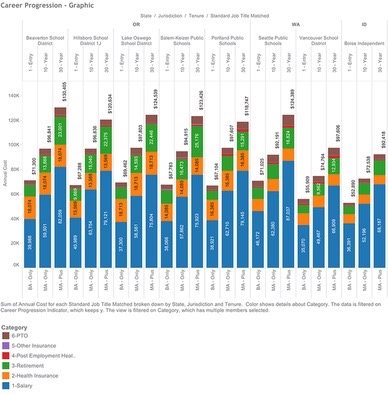
Health care and retirement make Oregon teachers pricey 

High health insurance and retirement costs make teachers more expensive in many Oregon school districts than in Vancouver or Boise, according to a new study by Portland State University's Center for Public Service.
And that disparity is likely to worsen as public employers' retirement costs in Oregon jump higher in the next five years to bail the state pension system out of its $22 billion funding deficit.
The study comes at a time when Oregon legislators are looking to trim both health care and retirement costs for public employees in their efforts to close a $1.4 billion budget shortfall. It is the latest of several studies from the Center for Public Service looking at public employers'
compensation costs. 
The biggest driver was employer-paid health insurance, which was consistently highest in Oregon. The study said the cost of that coverage ranged from $13,569 in Hillsboro to $18,713 in Lake Oswego. That compares to $10,016 in Seattle, $9,360 in Vancouver and $7,320 in Boise.
Retirement costs get a lot of attention in Oregon, as they are set to jump in each of the next three two-year budget cycles. The study looked at current costs, so it didn't take those increases – set to begin in July - into account. Districts in Washington and Idaho are not facing those increases.

Thursday, June 8, 2017

License to extort, power to abuse

HB 2004

There's more than one way to skin a cat, 
but it's probably going to be more expensive.

If approved, Senate amendments to HB 2004 will allow, even encourauge tenants to extort concessions from their landlords when an eviction (or rent increase) is imminent.  If there are no real mantnance issues that a tenant can use to hold onto an apartment, they can always be created.  Oops!
So sorry, things just keep breaking here every 60 days.  

Landlords have used no-cause "eviction", or non-renewal of leases, as a way to weed out undesirable tenants without the expense and trouble of using the court system.  Most people don't undestand that this process has huge benefits for tenants:  By not going to court, a tenant avoids having a formal eviction on their record that will be used to exclude them from future rentals.  Laws that prohibit no-cause "evictions" will force a court case and add to the cost of doing business, but will not keep undesirable tenants in an apartment.  

In business, over-regulation makes everything more expensive.  Costs ALWAYS get passed on to the people who can least afford it.  It's one thing to create a fair business environment, but when government starts picking winners and losers, we all lose.  

Rent control that limits a landlord's income would be disastrous for everyone, but even if this option isn't in the cards this legislative session, it isn't a win for anyone when government piles on costs that makes life more expensive for everyone.  


A Proposal to Allow Rent Control in Oregon is Probably Dead

Portland Mercury, May 31, 2017 By Dirk Vanderhart

The rent control dream appears dead. 
After the Oregon House of Representatives earlier this year passed a bill that would kill the state's pre-emption on local limits on rent hikes, a Senate committee this afternoon chopped that provision before moving the legislation before the full Senate.
The removal came in a package of amendments taken up by the Senate Committee on Human Services during a work session. The amendments' passage means cities and counties likely won't win permission to adopt so-called "rent stabilization" policies that limit what landlords can charge. Legislators had heard from hundreds of renters, advocates, and landlords embroiled in the heated debate over the state's soaring rent costs. 

Interesting to see who the "winners" and "losers" are according to the press, activists and popular, albeit uninformed opinion.  

"Rent Stabilization" is a euphanism for rent control which caps a rental housing owner's income.  No one should be fooled by the name switcheroo.  There are other forms of "rent stabilization" that make doing business more difficult and expensive and interferes with productivity and raises prices.

The vote diminished the hopes of activists and advocacy groups who'd seen their caused championed by House Speaker Tina Kotek in this year's legislative session, but could not find much muscular support in the House Senate.

Both Holland and Black still see promise in the bill that's now before the full senate. It would prevent landlords from issuing no-cause evictions to tenants who are at least nine months into a month-to-month tenancy (a more lenient standard than six months, which had been in the bill), instead only allowing eviction for a set of "just" causes. The bill would also prevent no-cause evictions within 60 days if a tenant asked for necessary repairs, and prevent a landlord from raising the rents on a tenant more than once every 12 months, among other things. 

Those are wins, Black says, but they won't allow the City of Portland to create a policy for limiting rental increases within the city, which local leaders had pushed for and had been one of PTU's main goals of the session.

Wednesday, June 7, 2017

THEY know how YOU should live

Of course THEY do. 

And THEY will make sure WE live the way THEY want.  It doesn't matter anymore what YOU or I may want or think.  OUR thoughts, wishes, dreams, yearnings and freedoms to choose how to live are of little consequence.  That part of the Constitution that guarantees life, liberty, and pursuit of happiness (and property) ---- t's not about You.  It obviously means Constitutuional guarantees are for THEM, our betters.

Even if you think Seattle's new sugar tax is a good idea, or you don't consume sugary drinks, or you think this is too silly to worry about, then which good idea of someone else's will you finally object to? When will government intrude into YOUR life?  It really isn't a matter of if anymore - an unrestrained government that is already involved in so many aspects of our private lives can easily convince us that just one more coercion is OK.  And then one more.  

Do you still not think of politicians and the vast government machine sees itself as a separate and elite class?  Take a look at how Seattle is treating diet soda.  I assume the Seattle City Council is highly educated and well paid so they don't see the conflict.  And it appears the Council is giving themselves the tax money for their own projects, though personnel costs will take the first bite.  


Here's a radical idea - make the soda tax "equal" and throw it out!  Don't YOU have use for the extra cash?  And save the taxpayer the cost of a new administrative division within the City's finance and code departments.
*
A Constitution of Government once changed from Freedom, can never be restored.  
Liberty, once lost, is lost forever. 

-- John Adams, Letter to Abigale Adams, 1775
*
Seattle Times

Seattle will tax sugary soda — but not diet

Diet soda won’t be taxed, and the council also chose to exempt baby formula, medicine, weight-loss drinks and 100 percent fruit juice.

Sports drinks such as Gatorade, energy drinks such as Red Bull and fruit drinks such as Sunny D all will be taxed, along with syrups used in soda-fountain pop.


Note about fruit juice: Livestrong.com

According to Dr. Andrea Sanigorski of Deakin University in Australia, fruit juice could actually be playing a part in childhood obesity. Many parents believe that because they’re giving their kids “healthy” juice, they don’t have to limit the amount. The truth is that fruit juice contains a high amount of sugar in the form of fructose. Your body cannot distinguish between sugar from fruits and sugar from candy. Once you’ve consumed sugar, it’s all processed the same way. To avoid health problems later in life, be aware of what juices contain the most sugar so you can moderate how much you drink.

Grape Juice:  A 12 ounce glass of grape juice contains over 58 grams of sugars. This is 20 grams more than a 12 ounces can of Coca-Cola. At 240 calories per 12 ounces, it’s also the fruit with the highest caloric value.

Apple Juice:  A 12 ounce serving contains 39 grams of sugar -- just 1 gram less than in a glass of soda. That’s about 10 teaspoons of sugar.
Orange Juice:   At 33 grams per 12 ounce serving, it falls slightly behind Coca-Cola. However, a glass of soda contains about 145 calories, while a glass of orange juice has 165 calories.
Boxed Juices:  Boxed juices are rarely 100 percent juice and instead have added flavorings, colorings and sugars. Juices made from concentrate are usually higher in sugar, as they sometimes contain high-fructose corn syrup or other artificial sweeteners.  Compare labels.  

Metric Conversion:  
1 Tablespoon of granulated sugar volume = 12.5 grams of granulated sugar mass


Wine Folly (Wine chart)
The sugar in wine primarily comes from the fruit sugars in wine grapes (fructose and glucose). Of course, there are a few instances where cheap wine producers will use sugar or grape concentrate to sweeten a wine.  
Note:  125 g = 4 oz (1/2 cup) fluid.  Wine sugars range from 0g - 22g sugar per 100g wine. Some wines have about twice as much sugar as coke.   Should wine be taxed extra?


Seattle Passes Regressive Soda Tax
By Christian Britschgi, June 6, 2017
reason.com/FREE MINDS AND FREE MARKETS

The city will now tax soda at a rate eight times higher than beer.

Seattle's city council passed a new soda tax yesterday over the loud opposition of local business owners, teamsters, and other citizens. At 1.75 cents per ounce—that $2.52 per 12-pack—the new rate will be eight times higher than the levy on beer.
"I think after this tax my store is going to be closed," one business owner told the councilbefore the vote. The storekeeper operates his shop on the edge of Seattle, and now will have to compete with neighboring communities that have no soda tax.
SodaRex Sorgatz/FlickrSeattle's city council passed a new soda tax yesterday over the loud opposition of local business owners, teamsters, and other citizens. At 1.75 cents per ounce—that $2.52 per 12-pack—the new rate will be eight times higher than the levy on beer.
"I think after this tax my store is going to be closed," one business owner told the councilbefore the vote. The storekeeper
operates his shop on the edge of Seattle, and now will have to compete with neighboring communities that have no soda tax.
"It is going to be very hard on small businesses," said another shopkeeper. "I just want to let you know that we are barely surviving on the minimum wage increase." Seattle passed a $15 minimum wage bill in 2014.


The council was unmoved, passing the measure by a vote of 7-1. The tax will go into effect after Mayor Ed Murray signs the bill.
When Murray and Councilmember Tim Burgess introduced the tax in April, they presented it as a way to encourage healthier lifestyles among minorities and to fund programs that will help close Seattle's racial achievement gap. (Among the recipients: early childhood education and subsidies to farmers markets.) The original proposal also included a tax on diet beverages, on the theory that this would make a regressive tax more equitable. In the mayor's words, "the data showed that the diet drinks were consumed by more middle-class white people." But the ordinance that passed yesterday left out the diet drinks.
Several activists who spoke on behalf of the measure acknowledged that the tax is regressive but argued that this would be mitigated by the spending it will allow. "We understand this is a regressive tax," said a dietitian with the group Got Green. "We only support it because we know and are pushing for it to go back and serve the community." Mackenzie Chase of the Save the Children Action Network echoed the point: "Early learning is a smart investment. We have a dramatic need for an investment and this is a smart way to do that."
Yet 80 percent of the revenue from the tax will go straight into Seattle's general fund, with no restrictions on how it can be spent. For the other 20 percent, the spending will follow a weak and non-exclusive list of priorities, including the administration of the tax and, perhaps most insultingly, training for workers who lose their jobs as a result of the tax. So even if it made sense to tax low-income Seattleites so that supposedly smarter officials could then give the money back to them in the form of services the government thinks they need, there's no guarantee that the soda tax will do even that.


Beautiful minds - Beautiful visions

National Geographic: Photo of the Day 
By National Geographic
May 27, 2017

What's in your mind's eye begging to be seen by others?

These images are from Photo of the Day, where you can see compelling images taken by our Your Shot community and submit your best photos for a chance to be featured.


Photograph by Karsten Hoenack, National Geographic Your Shot
Photographer Karsten Hoenack says that he was “totally overwhelmed” by the beauty of this mountain chain in Coahuila, Mexico. “Mexico is one of those countries which surprises you around every corner,” he says. 


 Photograph by RaNa Chakrabarti, National Geographic Your Shot
A fruit vendor naps after her lunch in the Kothapet market near Hyderabad, India. The Kothapet fruit market is the largest of its kind in the whole state of Telangana.


 Photograph by Apu Jaman, 
National Geographic Your Shot
In Bangladesh, a worker in a brickyard carries stacks of bricks out from the kiln. The nation is growing rapidly, and the need for construction materials is constant.


Photograph by Mustafa Varol, 
National Geographic Your Shot
A goatherd treks through the snow in Beysehir, Turkey. According to the Food and Agriculture Organization of the United Nations, there are 65.5 million goats and sheep in Turkey-- which works out to about 215 goats per square mile.


Home sellers cash in amid housing crisis!

Home buyers are shut out while sellers rake in big bucks 

Price gouging accused for unaffordbility of single family homes as greedy owners take advantage of those seeking to buy amid housing shortage.  Panicked home buyers pay thousands above asking price for questionable purchases risking a new housing bubble.  

Caps on home prices are being considered by legislature to curb rising housing costs.  Potential buyers protest excess profit being taken by sellers that excludes them from the market and is forcing them to move to outlying cities or continue living in undesirable housing.  

Homeowners cry foul about limits to profits while thousands of people with little money for down payments are shut out of the market. State and local governments seek emergency legislation as solution to housing instability and social and economic justice crisis.*


U.S. home prices rising 2 times faster than wages

Josh Boak, Associated Press9:08 a.m. ET May 30, 2017    
Washington — U.S. home prices climbed in March at the strongest rate in nearly three year as a dwindling supply of houses for sale is causing prices to significantly outpace income growth.
The Standard & Poor’s CoreLogic Case-Shiller 20-city home price index released Tuesday rose 5.9 percent over the past 12 months ended in March, the most since July 2014. Home values are increasing at more than double the pace of average hourly earnings, making it more difficult for many people to afford to buy a home.
“Over the last year, analysts suggested that one factor pushing prices higher was the unusually low inventory of homes for sale,” said David Blitzer, managing director and chairman of the index committee at S&P Dow Jones Indices. “People are staying in their homes longer rather than selling and trading up.
A steady job market has bulked up demand among many would-be buyers, but there are fewer properties on the market. Sales listings have plummeted 9 percent over the past year to 1.93 million, according to the National Association of Realtors. The shortage of homes to buy has caused prices to rise sharply in many metro areas.
The largest annual gain was in Seattle, where prices have surged 12.3 percent. Portland, Oregon recorded a 9.2 percent increase, while Dallas prices rose 8.6 percent.
Of the 20 cities in the index, the weakest gain was in New York City—an area where home prices are already high relative to median incomes. Home prices in New York City have risen 4.1 percent in the past year, still much higher than U.S. average hourly earnings that have increased 2.5 percent over the past 12 months, according to the Bureau of Labor Statistics.
*  The text above asks the reader to make comparisons to current housing-related issues that are being considered by state and local governments.  (HINT:  If you are still confused, replace 'homeowner" with "landlord" and "buyer" with "renter."  All sales including rents are legal transactions and require equal treatment and protection.)  

The new "normal" for housing nationwide is changing from one where 30% of gross income is spent on housing needs to over 50% and competes with medical, food, energy, water and other necessities.  Society must ask the questions - what is a necessity, and what is governments role in providing it - or forcing others to provide it at their expense?  

For most commodities there is an easy solution - allow the free market to supply what the customer demands at a price they will pay.  Regarding housing, when population or in-migragion decreases, or housing units (houses or rentals) increase, prices will stabilize.  Like everything else, the days of "cheap" housing are in the past.  

Tuesday, June 6, 2017

Where are rents going?

higher?  lower?  holding steady?  

It depends. 

The answer depends upon where you live, but rents are currently trending in the tenants' favor.  For a look at Portland's multifamily market as of May, 2017, see what the Portland State University Center for Real Estate Quarterly Report has to say:
 Multifamily Analysis

By Carlo Castoro 
This year may prove to be the crescendo of a six year multifamily construction and rent growth boom for the Portland metropolitan area. New deliveries and vacancies are up while rent growth is down and even reversing in some parts of the central city core. However, as the saying goes “All real estate is local.” Digging deeper into the numbers reveals robust rental growth in select submarkets while others follow suit with downtown. 

Supply must be catching up to demand! The free market works.  (Duh.)

In case you want to jump in to complain that rents have been and are still too high, then you might want to look back to see that things have not always been this way.  If landlords have been fortunate enough to have had some good years recently, it doesn't erase the fact that there have been some lean years too. When landlords were taking a beating, tenants were not up in arms protesting.

Commercial real estate cycles eventually balance out before they swing in the other direction as supply and demand work to reach an equilibrium, over and over.  Renters and landlords are in this dance together as the balance shifts - unless government interference or an economic disaster upsets the cycles.  Unfortunately, Portland has been discovered - by newcomers as well as investors - which adds extra pressure on rents and wider swings in the cycles.

Luckily for all, nothing can stop the cycle from self-correcting - EXCEPT - ill-conceived government interference, aka: rent control, rent stabilization, inclusionary zoning, etc.  How ill-informed and unreasonable are Oregon governments these days?